AI SEO Automation Explained: How It Actually Works
If you've tried to run SEO for a small business or a solo project, you already know the drill. You open a keyword research tool, export a spreadsheet, paste the best keywords into a separate AI writer, edit what it gives you, copy the result into your CMS, then jump over to Search Console and an analytics dashboard to see if any of it worked. Six tools, zero continuity between them, and no obvious way to feed what you learn from step six back into step one.
"AI SEO automation" gets used loosely to describe a lot of different things, from a single AI writing plugin to a full research-to-publishing pipeline. That looseness makes it hard to know what you're actually evaluating when you look at a tool. This post breaks down what AI SEO automation actually means in practice, where a human still needs to be in the loop, and how we've approached it while building UpCite.
Why the SEO Content Workflow Is So Fragmented
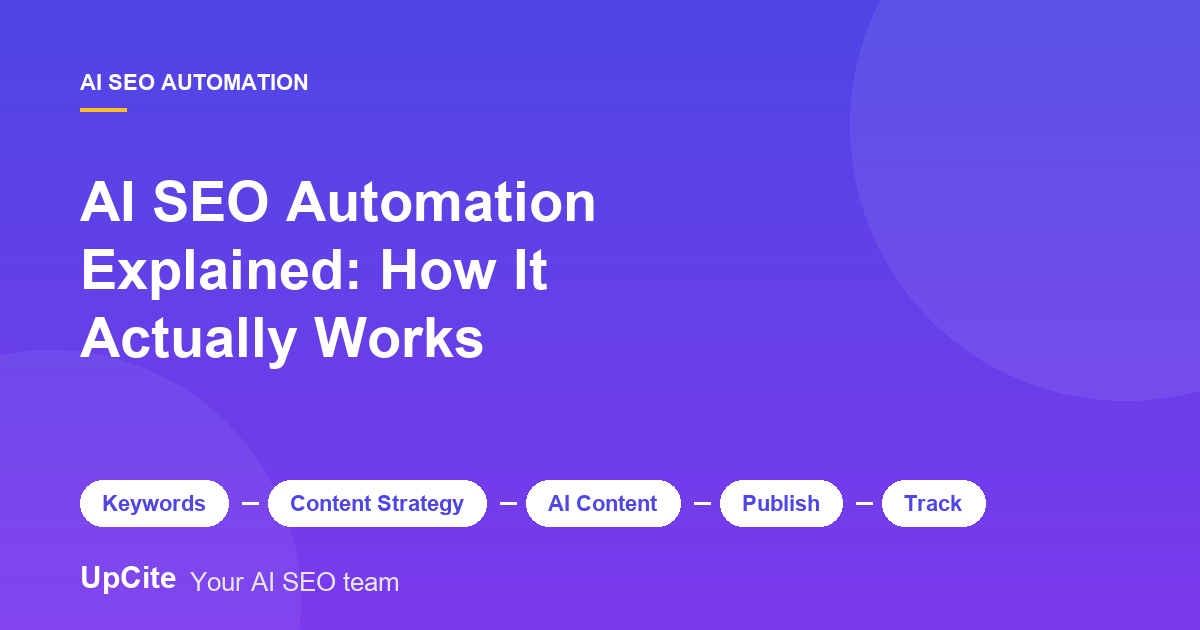
Most SEO work breaks down into four stages: finding keywords worth targeting, turning those keywords into a content plan, writing the content, and publishing and tracking results. Each stage usually lives in its own tool, built by a different company, with its own login and its own way of exporting data.
That fragmentation isn't just annoying, it actively loses information. A keyword research tool doesn't know what you've already written. A writing tool doesn't know which topics are actually driving traffic. An analytics dashboard doesn't feed anything back into what you plan to write next. Every handoff between tools is a place where context gets dropped, and for a solo founder or a small team without a dedicated SEO hire, that's usually the point where the whole process quietly stops.
What AI SEO Automation Actually Means
Stripped of the hype, AI SEO automation means using AI at each stage of that workflow, keyword research, content planning, writing, and reporting, while keeping the stages connected to each other instead of separated by exports and copy-pasting. The "automation" part isn't about a single prompt producing infinite content. It's about removing the manual handoffs between stages so the output of one step becomes the input of the next automatically.
That distinction matters. A tool that only automates the writing step still leaves you doing manual keyword research, manual publishing, and manual tracking, which means you've automated the easiest part and kept the tedious parts. The workflow only actually gets easier when research, strategy, creation, and measurement share the same data.
The Workflow, Stage by Stage
Here's roughly what a connected AI SEO workflow looks like end to end:
| Stage | Traditional approach | Connected AI SEO workflow |
|---|---|---|
| Keyword research | Manual search, exported to a spreadsheet | Automated discovery based on your actual site and audience |
| Content planning | Keywords manually grouped into a plan | Keywords automatically clustered into topics and prioritized |
| Content creation | Written from scratch, or by a separate AI writer with no site context | Drafted with awareness of your site, audience, and existing content |
| Publishing | Copy-pasted into a CMS by hand | Published directly, with human review as the default checkpoint |
| Measurement | Checked separately in Search Console or analytics | Tracked in the same system, feeding back into what to plan next |
The last row is the one that's easy to skip and matters the most. Without a feedback loop back into planning, you're repeating the same research process from scratch every time, instead of letting performance data tell you what to write next.
Where Humans Still Belong in the Loop
It's worth being direct about this: no AI SEO tool, including UpCite, can guarantee a specific Google ranking. Google says the same thing about SEO providers generally: no one can guarantee a #1 ranking, and any provider who claims otherwise is a red flag. Rankings depend on competition, domain authority, and search algorithm changes that no platform controls. What automation can reasonably promise is removing the manual grunt work of research, drafting, and publishing, not the outcome itself.
That's also why human review matters. In UpCite, every article goes through a review stage by default. You read it, edit anything that needs fixing, and approve it before it publishes. That's a deliberate choice for where we are today: a system that drafts content with real context about your site is genuinely useful, but full autonomy without a human checking the output isn't something we think is ready to ship as the default, for us or anyone else in this space.
What This Looks Like With UpCite
Concretely, the workflow we're building starts with connecting your website so UpCite can understand your business, audience, and existing content, rather than generating generic output with no context. From there it identifies keyword opportunities and search intent, groups them into a prioritized content plan, drafts SEO-structured articles for review, and publishes to your CMS once you approve. WordPress publishing is supported today, Shopify and Webflow integrations are coming, and a REST API is available if you're running a custom CMS. Performance tracking closes the loop by feeding rankings, traffic, and engagement back into what gets planned next.
That's the current version, what we're calling the SEO Content Engine. The longer-term direction is a more autonomous system that continuously monitors rankings, watches competitors, and surfaces what to write next without being asked. We're not there yet, and we'd rather be upfront about that than oversell where the product is today.
The Takeaway
AI SEO automation is genuinely useful when it connects the stages of SEO work that are normally isolated in separate tools: research informing strategy, strategy driving content, content getting published, and results shaping what comes next. It's less useful, and sometimes actively misleading, when it's marketed as a single AI writer bolted onto a workflow that's still fragmented everywhere else.
If you're evaluating tools in this space, the question worth asking isn't "does it write content with AI." Most things do now. It's "does the output of each stage actually feed the next one, or am I still the one stitching it together." Join the UpCite waitlist if you want to see this approach in action. Waitlist members get 3 months free once we launch, no card required.
Ready to grow your organic traffic?
UpCite finds the keywords, writes the content, and publishes it for you.
Join the Waitlist